Bay Scallop Die-off related to Climate Change?

Publication: The Southampton Press By Michael Wright   Nov 5, 2019 10:25 AM

Nov 5, 2019 4:59 PM

Dead Bay Scallop

A massive and mysterious die-off of bay scallops over the past summer wiped out as much of 95 percent of the valuable and iconic shellfish in parts of the Peconic Bay system, raising concerns about the effect that climate change may have on the future of the East End’s most famous natural resource.

The scale of the losses, the scientists who have documented the destruction said, is so great in some areas as to be reminiscent of the devastation wreaked by some of the infamous “brown tide” algae blooms of the late 1980s and early 1990s, which decimated the wild stock and all but ended a centuries-old commercial fishing industry that relied solely on harvests from the East End’s bays.

The cause of this year’s devastation is not immediately clear, but scientists say that the arch-enemy of bay scallops — algae blooms like brown tide and the more recent “rust tide” — do not appear to be at fault, and other likely culprits also do not seem to be to blame.

What’s left to blame, according to one of researchers who has tracked the die-off, is a confluence of environmental conditions and the stresses of the scallops’ own biological cycles that may have killed the shellfish, even as they sowed the seeds of next year’s stock.

There is some good news amid the devastation, primarily because half the reason that the scale of the die-off is remarkable is that there were so many live scallops to start with — and they appear to have spawned before they died, leaving huge numbers of their offspring in their place.

Population Takes A Nose Dive
Surveys conducted by Cornell Cooperative Extension biologists last spring had revealed that the annual “set” of young-of-the-year scallops was enormous and on track to support a commercial take rivaling or surpassing those of the robust hauls of the last two years.

But when the scientists donned wetsuits and returned to their underwater survey areas throughout the Peconics early last month, they found the ghostly signs of an epic massacre: thousands of scallops sitting where they died, their shells gaping open.

“We call them ‘cluckers,’” Dr. Stephen Tettelbach, who leads the surveying for Cornell, said of the dead scallops, whose twin shells have remained attached and sitting on the bay floor. “Based on the cluckers, it looks like the mortality happened a while ago — a few months, probably. The pattern was the same everywhere we went — there were no freshly dead adult scallops. They had no tissue left in them. So whatever happened to them happened a while ago.”

A longtime marine biology professor for Long Island University at Southampton College and C.W. Post College, Dr. Tettelbach has been conducting bi-annual surveys of scallop populations since LIU and Cornell began an effort to restore the scallop stocks depleted by the brown tides that beset the bays between 1986 and 1995. Through the Cornell hatchery in Southold, the initiative released more than 10 million seedling-sized scallops into the bay over the last two decades in the hope of restoring the spawning foundation for the species.

Looking For Answers
Since discovering this year’s die-off, Dr. Tettelbach and other scientists have been exploring what could have caused the mortality.

The destruction of harmful algae blooms was quickly ruled out, because there were none in the Peconics this year — the second straight year that the destructive successor to the brown tides, a red algae bloom that scientists have dubbed “rust tide,” has been absent from local bays, after a 15-year run of increasingly dense blooms.

Dr. Tettelbach himself had pinned a large die-off of scallops in the same area in 2012 on the dense blooms of rust tide that killed what had looked to be a robust stock just weeks before the harvest began.

The second thought about this year’s event — a disease of some sort — also is being seen as unlikely, because the die-off does not appear to have extended to juvenile scallops, which the survey divers saw alive and in great abundance.

And the vast extent of the mortality could not be chalked up to the usual cast of submarine characters that prey on scallops like crabs, whelks and some fish species.

But there was a wild card this year in the form of an invasion of a certain species of shellfish-eating stingrays that have wiped out oyster beds in the Chesapeake Bay.

Thousands of cownose rays, a brown-winged creature that feeds primarily on shellfish, swarmed into East End waters in July and August, roaming the bay bottoms in schools of dozens or hundreds.

Dr. Tettelbach said there were accounts of the rays being seen in Hallock Bay, in Orient, but he has not yet confirmed that they made their way deep into the Peconics. He said the rays could explain the disappearances in some of the areas where large number of scallops had been seen in the spring, and now there are no signs of them at all.

But the species would not be easy to blame for the full extent of scallop losses this summer, since there were so many intact shells left behind as a sign that the scallops simply died where they sat. The shells of scallops set upon by the rays would be crushed, he said.

A Matter Of Climate?
Eliminating those considerations turned the former professor’s critical thinking to other environmental factors, and the warm temperatures of the summer.

Data from water monitoring stations at the western end of the Peconics revealed that water temperatures hovered around 84 degrees for several weeks this summer — an unusually long stretch of exceptionally high temperatures, and near what is understood to be the lethal limit for scallops.

In a typical parallel, levels of dissolved oxygen in the water were also very low — near zero at times — which typically will result in the death of any marine species.

But those conditions have occurred before at various times of past summers, and broad die-offs of scallops were not seen.

Dr. Tettelbach said his hypothesis is that the high water temperatures and low dissolved oxygen levels had set in early enough this year as to coincide with the weeks of early- to mid-summer when scallops are going through their first spawning cycle — some will spawn again in the fall — which can weaken them and make them more sensitive to environmental conditions.

“What I’m thinking is that the stress from spawning combined with environmental stressors may have been the cause,” he said, noting that if his hypothesis is correct, it would exacerbate concerns about a trend of warming waters. “We’ve had water temperatures in the Peconics over 80 degrees the last five years. Years ago, we never saw that.”

Impacting Local Economy
Word of the scientific findings was not news to area baymen, some of whom routinely do their own pre-season surveying to keep tabs on their economic prospects for the fall.

Many didn’t even set out in their boats in search of scallops on Monday, the first day of the season in New York State waters.

“I went clamming today,” Edward Warner, a bayman from Hampton Bays, who is also a Southampton Town Trustee, said on Monday. “The only other time I can remember not going scalloping on the first day was, maybe, 1986, the first year we had the brown tide.”

Among those who did go, many found little return for their efforts.

“I had 14,” said Stuart Heath, a bayman from Montauk who scoured traditional scallop grounds in Shelter Island Sound. “I went all around North Haven, from Margarita guy’s house … to Sag Harbor, around the moorings, Barcelona, all around Northwest. Terrible. We’ve had a terrible year already — now this.”

Wainscott bayman Greg Verity said he ran his small boat across to the North Fork and found enough scallops to fill several bushel baskets, but he was still well short of the 10 bushels that a bayman is allowed to harvest each day.

East Hampton’s baymen said there’s only a faint glimmer of hope, when East Hampton waters open next week, that there may be some scallops lurking in areas that haven’t been prospected.

The Cornell scientists conduct their surveys in the string of bays connected to Great Peconic Bay, from Flanders Bay in the west to Orient Harbor in the east. They do not survey any of the waters off East Hampton — where scalloping is not allowed until this coming Sunday.

Pre-season scouting has not given East Hampton’s baymen much cause for hope, either.

Mr. Heath and Mr. Verity said they’d heard talk of scallops in Three Mile Harbor, where the town releases thousands of hatchery-raised baby scallops each year. But that supply is often depleted quite quickly, especially when the harvest in other areas is poor.

On Monday evening, Mr. Verity and Sara Miranda were counting themselves as lucky while they shucked their way through the briny pile of scallops on a steel table set up in a trailer next to Mr. Verity’s cottage in Wainscott.

“I’ll sell ’em to whoever wants ’em,” he said, as he flicked the glistening white morsels of meat into a pile.

The scene was not being replicated in many of the seafood shops around the region.

“So far, we’ve got nothing, not even one bushel,” said Danny Coronesi at Cor-J Seafood in Hampton Bays, one of the areas largest buyers.

“I’ve been here a long time. We’ve never had this. Even on bad years, opening day some guys would come in with them.” He added, “We had thought this was going to be a great year.”

Comment from Win With Wind: Scientists quoted think global warming is causing this die-off. Are scallops the canary in the coal mine for the marine environment and when will all local fishermen understand that global warming will destroy their industry, not offshore wind? 
Take-aways from the new LIPA Fact Sheet

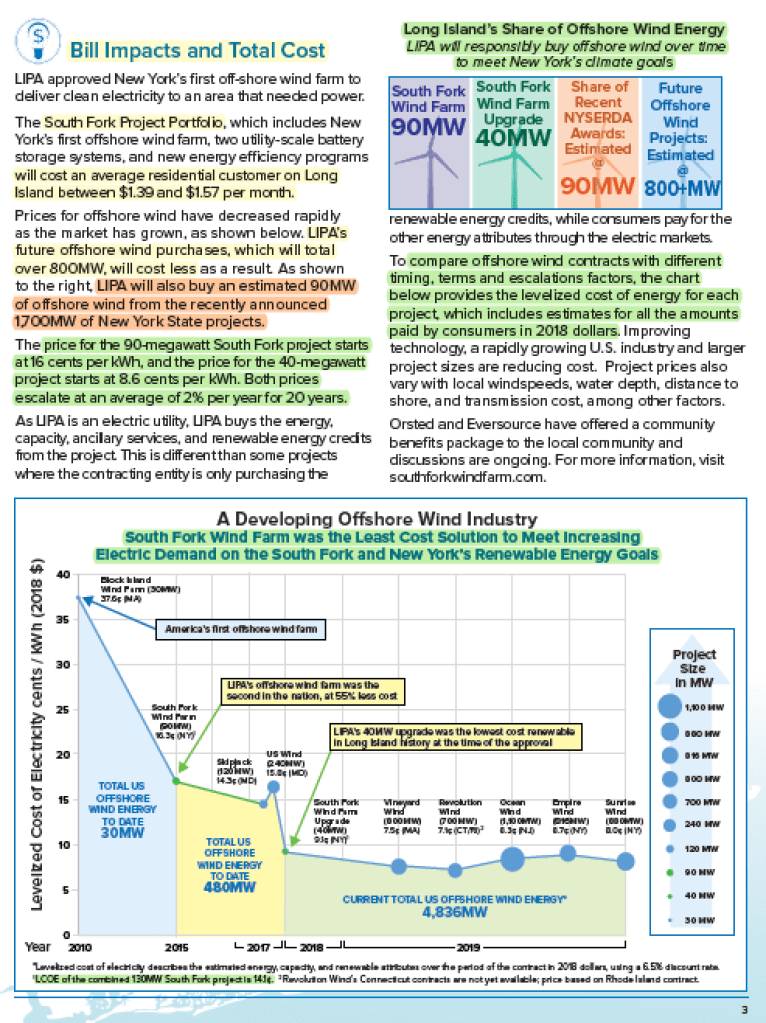
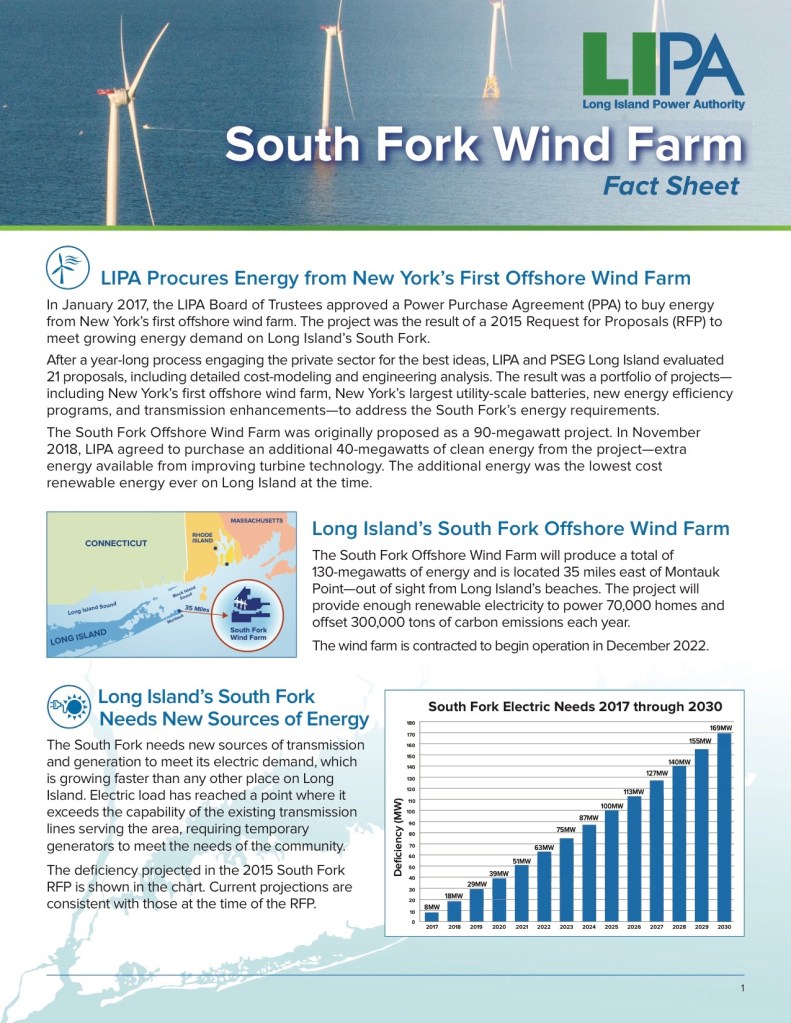
For what it’s worth, here are my main take-aways from the new LIPA Fact Sheet (attached below with highlights added) on the South Fork Wind Farm:

1.       South Fork Wind Farm was the least cost solution to meet increasing electric demand on the South Fork and New York’s renewable energy mandates.

2.       LIPA’s share of New York State’s 9,000 MW offshore wind target is over 1,000 MW and SF Wind Farm is the first of many projects to meet the Long Island goal.

3.       The South Fork RFP Portfolio (Wind+Storage+Demand Response) will cost the average residential customer on LI between $1.39 and $1.57 per month.

4.       The price LIPA pays for the 90 MW SFWF starts at 16 c/kWh; the price for the additional 40 MW (contracted in Nov. ’18) starts at 8.6 c/kWh (this additional energy was the lowest cost renewable energy ever on LI at the time). The combined cost for the 130 MW would be about 13.7c/kWh in the first year. Prices escalate at an average 2% per year for 20 years. 

5.       Levelized Cost of Energy (LCOE) over 20 years for the combined 130 MW SFWF is 14.1¢/kwh (in 2018 dollars, using a 6.5% discount rate). Cost of other planned projects in the region are projected to be significantly lower but an ‘apple-to-apple’ comparison is difficult because these projects are much larger and benefit from economies of scale. They were also selected later and thus benefitted from lower industry price levels. 

6.       Prices for offshore wind power have declined rapidly in Europe due to increased investment and improving technology and we are now seeing price declines in the emerging U.S. offshore wind industry.

7.       LIPA’s future offshore wind purchases will total over 800 MW, and will cost less as a result of expected price decreases. LIPA will also buy an estimated 90 MW of offshore wind from the recently announced 1,700 MW of New York State projects (by NYSERDA).

8.       As a result of procuring offshore wind power spread out over many years (a decade or so) as prices decline, LIPA’s overall offshore wind portfolio cost will be minimized.

9.       When comparing costs of renewable energy to conventional sources we also need to account for costs which are typically not accounted for such as the cost of air pollution, climate, unknown fuel price risk, etc.

The bottom line, as I see it, is that all this demonstrates that the South Fork Wind Farm not only provides us with local, renewable and reliable power but does so at an affordable price. And over time we will get more and more offshore wind power at even lower prices. This will result in a very affordable average bill impact and could even provide significant savings over fossil fueled power if natural gas prices turn out to be higher than currently forecast.

I’m attaching a marked-up version of the LIPA Fact Sheet where I highlighted sections discussing some of the above points in context.

Best, Gordian Raacke, Executive Director

Renewable Energy Long Island

facebook.com/RenewableEnergyLongIsland

twitter.com/LIGreenGuide

page 1

page 2
page 2
page 3
page 4

Offshore windfarms ‘can provide more electricity than the world needs’

Supplies from turbines will prove to be the next great energy revolution, IEA predicts – International Energy Agency (IEA)

Jillian Ambrose Energy correspondent

In the Guardian, Fri 25 Oct 2019 04.23 EDT First published on Thu 24 Oct 2019 14.45 EDT

“Offshore wind currently provides just 0.3% of global power generation, but its potential is vast,” the IEA’s executive director, Fatih Birol, said.

The study predicts offshore wind generation will grow 15-fold to emerge as a $1tn (£780bn) industry in the next 20 years and will prove to be the next great energy revolution.

The IEA said earlier this week that global supplies of renewable electricity were growing faster than expected and could expand by 50% in the next five years, driven by a resurgence in solar energy. Offshore wind power would drive the world’s growth in clean power due to plummeting costs and new technological breakthroughs, including turbines close to the height of the Eiffel Tower and floating installations that can harness wind speeds further from the coast.

The next generation of floating turbines capable of operating further from the shore could generate enough energy to meet the world’s total electricity demand 11 times over in 2040, according to IEA estimates.

The report predicts that the EU’s offshore wind capacity will grow from almost 20 gigawatts today to nearly 130 gigawatts by 2040, and could reach 180 gigawatts with stronger climate commitments.

In China, the growth of offshore wind generation is likely to be even more rapid, the IEA said. Its offshore wind capacity is forecast to grow from 4 gigawatts to 110 gigawatts by 2040 or 170 gigawatts if it adopts tougher climate targets.

Birol said offshore wind would not only contribute to generating clean electricity, but could also offer a major opportunity in the production of hydrogen, which can be used instead of fossil fuel gas for heating and in heavy industry.

The process of making hydrogen from water uses huge amounts of electricity but abundant, cheap offshore wind power could help produce a low-cost, zero-carbon alternative to gas.

In the North Sea, energy companies are already planning to use the electricity generated by giant offshore windfarms to turn seawater into hydrogen on a floating “green hydrogen” project, backed by the UK government. The clean-burning gas could be pumped back to shore to heat millions of homes by the 2030s. The UK has committed to reaching net zero carbon emissions by 2050.

The overlap between the UK’s declining oil and gas industry and the burgeoning offshore wind sector could offer major economic benefits for the UK, Birol said.

“Offshore wind provides a huge new business portfolio for major engineering firms and established oil and gas companies which have a strong offshore production experience,” he said. “Our analysis shows that 40% of the work in offshore wind construction and maintenance has synergies with oil and gas practises.”

We have some news… about how we will respond to the escalating climate crisis – we will not stay quiet. This is the Guardian’s pledge: we will continue to give global heating, wildlife extinction and pollution the urgent attention and prominence they demand. The Guardian recognises the climate emergency as the defining issue of our times.

Our independence means we are free to investigate and challenge inaction by those in power. We will inform our readers about threats to the environment based on scientific facts, not driven by commercial or political interests. And we have made several important changes to our style guide to ensure the language we use accurately reflects the environmental catastrophe.

The Guardian believes that the problems we face on the climate crisis are systemic and that fundamental societal change is needed. We will keep reporting on the efforts of individuals and communities around the world who are fearlessly taking a stand for future generations and the preservation of human life on earth. We want their stories to inspire hope. We will also report back on our own progress as an organisation, as we take important steps to address our impact on the environment.

The Guardian made a choice: to keep our journalism open to all. We do not have a paywall because we believe everyone deserves access to factual information, regardless of where they live or what they can afford.

We hope you will consider supporting the Guardian’s open, independent reporting today. Every contribution from our readers, however big or small, is so valuable

Climate Change

Letter to the Editor from the East Hampton Star, 15-Oct-19

October 10, 2019

To the Editor,

The most effective lies are those that begin with something that is true. The letter in the Oct. 3 Star by Mr. Walter Donway is a case in point. He states that the climate has changed in the past, before humans were emitting greenhouse gases. That’s true but the conclusions he draws are false. Past climate changes, obviously with natural causes, generally took many millennia to play out, and they were often accompanied by mass extinctions.

In the present case, the scenario is playing out over decades — much shorter periods of time. And now we have more than seven billion human beings who have occupied every niche that the existing climate could support. Many of the most populated regions will become less able to support humans, and this will result in mass migrations that will make the refugee crises of this decade seem puny by comparison.

This is a big reason why our military is very concerned about climate change. It’s also why 66 Republicans joined the Democrats to defeat an amendment to the last defense appropriations bill that would have prevented the Pentagon from considering climate change in its strategic planning.

Mr. Donway also takes aim at climate models. Here again, he starts with the truth that models have shortcomings. If the only evidence for climate change came from models, I’d be a skeptic, too. Models are just one piece of the puzzle. The precisely measured increase in the concentration of carbon dioxide in the atmosphere, its correlation with the emissions from combustion of fossil fuels, the steady increase in global temperatures, and the shifting of the ranges of many species as they attempt to adjust to the changing climate, are solid pieces of evidence that have nothing to do with models.

What models contribute is an understanding of the complex mechanisms that together influence the climate. Models also tell us which uncertainties are most important and which ones can be safely ignored. The role of clouds in the climate system is one very important area where we need to refine the science, but the uncertainties here only lead to uncertainty about whether climate change will just be very bad or downright catastrophic.

It is quite possible that Mr. Donway really believes what he is writing week after week, just as many an isolationist in the 1930s really believed that Hitler was not a threat, but their beliefs didn’t change the reality. It’s probably too much to ask him to reconsider, but the rest of us don’t have to follow along.

Our young people have the most to lose, and they are beginning to lead the fight for sanity. Thank God for them.

JOHN ANDREWS, Sag Harbor

Authoritative Data

APPEARED YESTERDAY IN THE EAST HAMPTON STAR.

Fourteen Percent
Amagansett
September 1, 2019

To the Editor:

If you were enjoying a glorious ocean beach day, or hoeing your garden in hot sun, you might think East Hampton could achieve energy sustainability just by exploiting solar power. You would be wrong. Gordian Raacke, former executive director of the federal court-appointed citizens advisory panel created in 1993 to represent Long Island’s electricity consumers, has been studying the options for the last 26 years.In 2014, Raacke advised East Hampton Supervisor Larry Cantwell and the town board that they could not reach their goal of full sustainability through solar power alone.

In 2018, Raacke updated his research in a highly technical study of the estimated achievable potential of renewable energy sources over five years within the geographical boundary of East Hampton Township. Using authoritative data sources, the study assumed solar panels of every known type covering every feasible site in East Hampton, whether on rooftop or ground. It estimated that solar could provide a maximum 14 percent of annual electricity consumption over the next five years. For full sustainability the bulk of our power would need to be generated by offshore wind.

The reasons are plain. Much of East Hampton, ground and rooftop, is covered by woods and forests. Most of the sunny open space that could support panels on the ground is protected by law from further development. The rest is privately owned property too expensive for the town to rent or buy.

Our town board faced hard facts when it decided in 2014 that the town would need a major infusion of wind power to meet its sustainability goal. The current town board is doing the same. So should members of our community to resist the impacts of climate change on our beautiful environment.

Sincerely yours,

JEANNE FRANKL

A letter from Ashley: I am mobilizing (19 yo Riverhead student)

My name is Ashley Ambrocio. I am a member of Drawdown East End and Riverhead EAC (Environmental Advisory Committee).

When I learned of the magnitude of the climate crisis, I decided that I will not sit and watch.

When people hear about the negatives on this topic, they often cocoon or ignore it, because it seems like a problem to big too solve. It’s not “their problem”. I could not be one of these people because I do not have the luxury of not being affected by this crisis.

I have dreams and aspirations, things that, when I am older, I would like to say that I did during my life. Greta Thunberg once said “That she was fortunate to be born in a time and place where everyone told us to dream big; she could become whatever she wanted to. She could live wherever she wanted to. People like herself, had everything they needed and more. Things their grandparents could not even dream of. They had everything they could ever wish for and yet, now, we may have nothing” This is a reality all too real for those that are millennials or younger.

Many young people are becoming aware of this crisis and are taking action in the form of the Extinction Rebellion, Sunrise Movement, and many more. I am mobilizing with these kids because we want to ensure that we have a safe and happy future to complete these goals that we all have.  Although we are not the ones who caused the problem, we are very determined to fix it. But we need allies. We need those who have been alive to see this crisis unfold, to help us to ensure that my children and my grandchildren have the opportunity of a future. There are solutions that involve individual action, collective action and moving governmental policy.  

What I ask is to find that passion and curiosity, to lend some of your time and energy, and to join a group like Drawdown East End or Win With Wind and help solve the crisis.

We aren’t winning against this challenge. We need to see that this is the time to act. We need to seize the opportunity and turn climate change around. We need to help the younger generations that are inheriting this crisis and the generations that will come after us. We need to give them a stable, safe, and thriving world.   

South Fork Wind Farm

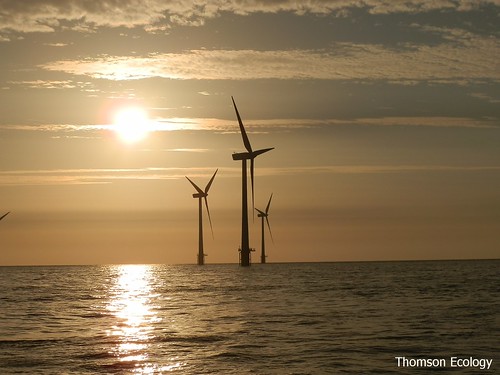
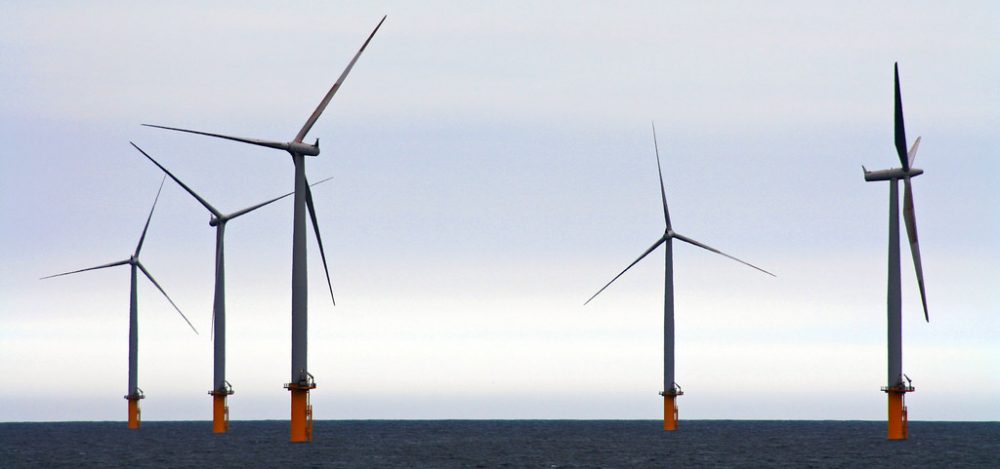
Offshore wind farm
From https://www.flickr.com/photos/thomsonecology/15079751399/

Submitted by Alice Tepper Marlin. (letter to the editor of the EH Star, July 2019)

The wind farm proposed to be sited out of sight, 35 miles off our shores, can make a significant contribution to slowing the climate change that so threatens our beautiful seaside community and all life on our precious, unique planet. It is crucial to our town commitment to be powered 100% by renewables by 2030.

To my consternation, opposition is being skillfully fomented by a few individuals who, for various self-interested reasons, loudly promote misinformation and even disinformation about the project and the company behind it, sowing unwarranted fear and distrust.

The brouhaha is over the onshore route of the transmission line carrying the wind-generated electricity from the turbines to the East Hampton substation. The entire line will be under ground. I have seen the equivalent on Block Island, and it is hardly noticeable. All you can see are occasional manhole covers.

Yes, there would be a few months of wintertime construction for installation, but the route from Wainscott is only four miles long and half of it is in the railroad corridor. So this disruption is in no way a big deal. Just a few months ago, ten miles of water main were installed in Wainscott, and not a peep was heard to challenge it.

What about Orsted? Orsted is a Danish renewable energy company and a global leader in offshore wind. Its new partner, Eversource, is a premier transmission builder with 100 years of experience providing energy in the Northeast. Orsted supplies over 25% of the world’s wind energy capacity. It has experience successfully building thousands of offshore turbines in Europe. Fishermen in England, The Netherlands, and France report positively, they say that the fish love these artificial reefs. If these were oil rigs, there would be not only climate damage but also occasional spills killing thousands of marine animals. What harm can we even imagine from a wind spill? In 2018, Orsted won aN award for the most socially responsible companies in the world.

Independent of East Hampton’s decisions, there will be two dozen government reviews before construction can begin. These will provide detailed environmental and other reviews at a technical level above and beyond what one might reasonably expect at the local level. Numerous top environmental groups are participating in the process. In addition, East Hampton has the right to submit all our questions and concerns in these processes. The town Board has already filed a submission.

The South Fork Wind Farm will be able to generate enough power for 70,000 South fork homes.

Our region has the fastest growth rate for electricity use on Long Island. Forecasts indicate that that all the electricity generated by the South Fork wind farm will be required in our local region But even if that proves not to be the case, what portion serves homes and businesses here and what portion serves homes elsewhere matters not a bit to its lessening of global warming and of the acidification of our waters. Acidification from burning fossil fuels has already been a factor in driving the lobsters north and harms all life in the ocean.

We as citizens have a duty not only to our local community but also to the nation.

Let’s think globally and act locally: let our Trustees and Board members know that you want to be counted and will welcome the wind farm.

Alice Tepper Marlin

Climate Change: Youth Activists

Youth climate activist movement in the USA: Greta Thunberg’s reach is vast. Check out Greta’s story here.

The youth shall inherit the earth…and they plan to take care of it. The growing youth activist movement has continued to expand across the world, and politicians are taking notice.

Coming up in EAST HAMPTON, NY, is this event:

https://www.guildhall.org/events/hamptons-institute/

  • Talk
  • Monday, August 5 7PM $25-$55 ($23-$50 Members) per evening for panel only | Special Tickets $500 per evening includes premium seating and post-performance reception with panelists

Eligible for Student Rush Tickets

Purchase tickets at the Box Office; 631-324-4050; or Theatermania.com at 1-866-811-4111 158 Main Street
East Hampton, NY 11937 United States Buy Tickets

Produced by Tracy Marshall and Sheraton Kalouria

Panelists:
Dr. Michael Mann, Director of the Earth System Science Center, Penn State University
Alexandria Villasenor, a Co-founder of US Youth Climate Strike and founder of Earth Uprising
Gordian Raacke, Executive Director of Renewable Energy Long Island

Our panel will address the latest science and focus on the young people around the globe that are taking action and impacting change.

Warmer Air, Heavier Rain, More Flooding

David Leonhardt writes in the NY Times about flooding in Grafton, Ill., a small town along the Mississippi River. Because of a bridge closure, the only other way for the vil­lage’s 1,000-plus res­i­dents is to the north via tens of miles of wind­ing, poorly paved coun­try roads that are barely wide enough to al­low a ve­hi­cle go­ing in each di­rec­tion,” The Wall Street Journal’s Erin Ailworth wrote recently. “A 20-minute drive to a gro­cery store now takes a few hours…”

It rained “heavily” all day long in East Hampton NY, on Thursday June 13th. One inch of rainfall according to https://www.localconditions.com/weather-east-hampton-new-york/11937/past.php The winds were out of the NE at about 10-20 mph. Nothing unusual, right?

I decided to take a drive down Gerard Drive. It is arguably one of the most sensitive areas to flooding and East Hampton Town has just completed an expensive fortification of the road to prevent ‘noreaster’ storms from crashing over the road in to Accabonac bay.

The road was passable with large puddles. About 50% of the private drive-ways were flooded.

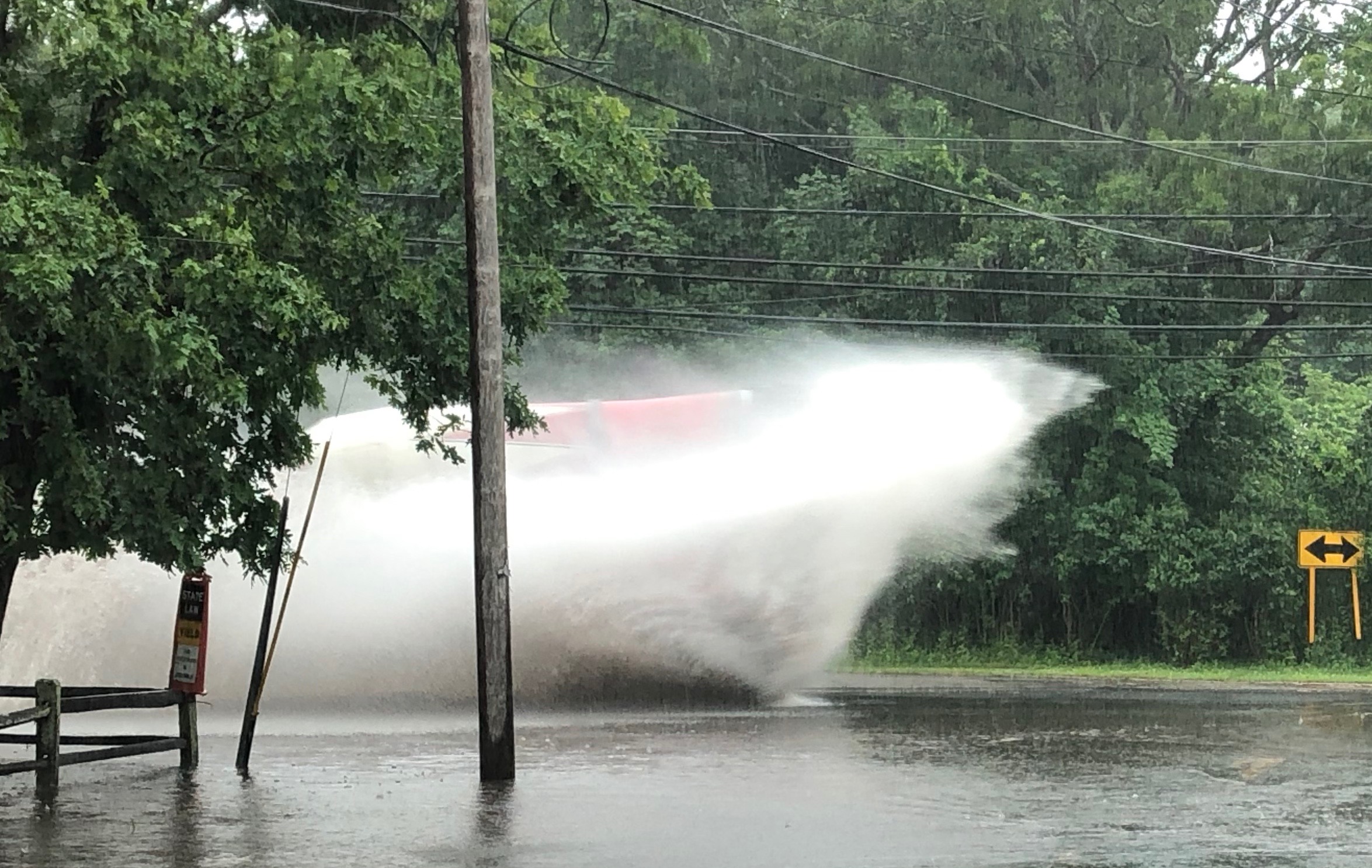
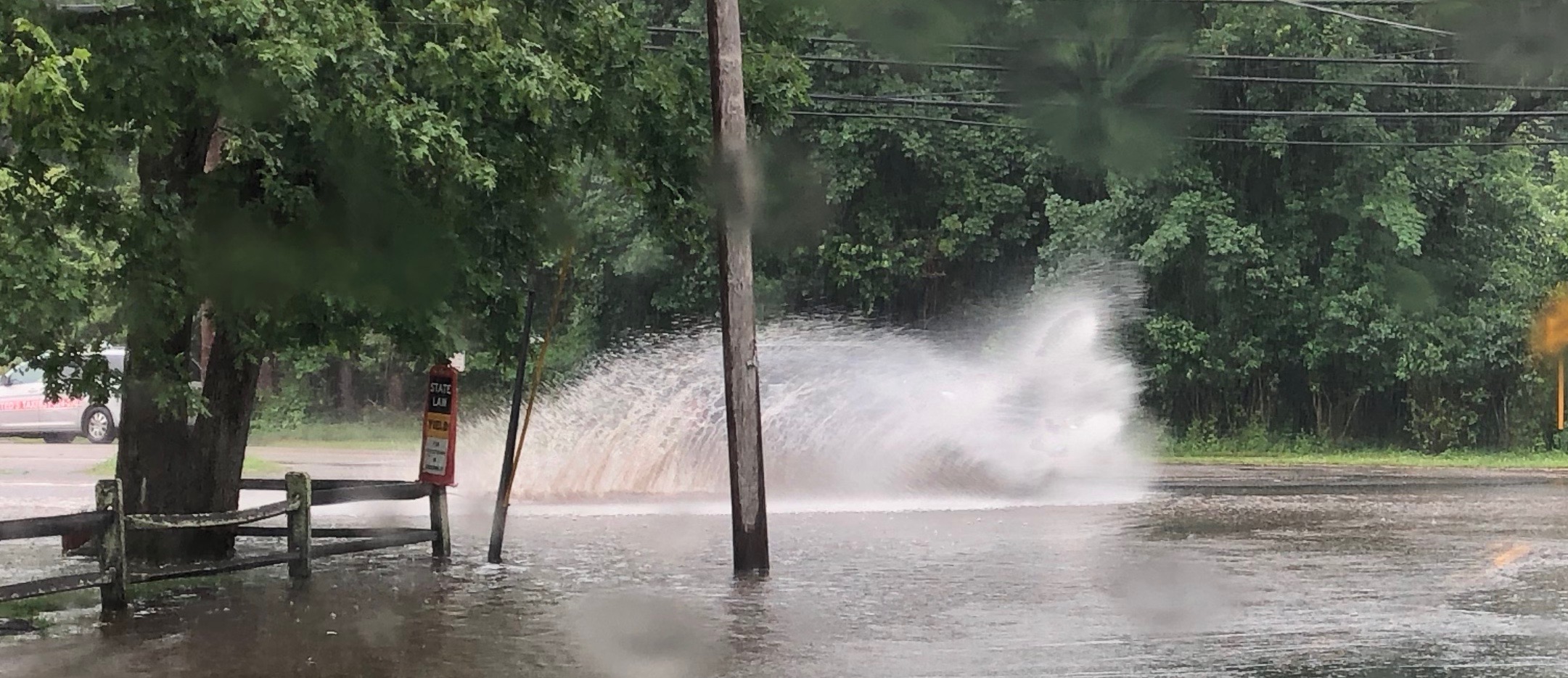
Then I visited the cross section of Springs Fireplace Rd. and Gardiners Avenue, just by Springs Auto (Edgar’s place). This place usually gets flooded with every storm, at least in recent memory. No surprise:

This kind of flooding was rare 30-40 years ago when I first moved to East Hampton. Perhaps only with a hurricane? Now it seems more common.

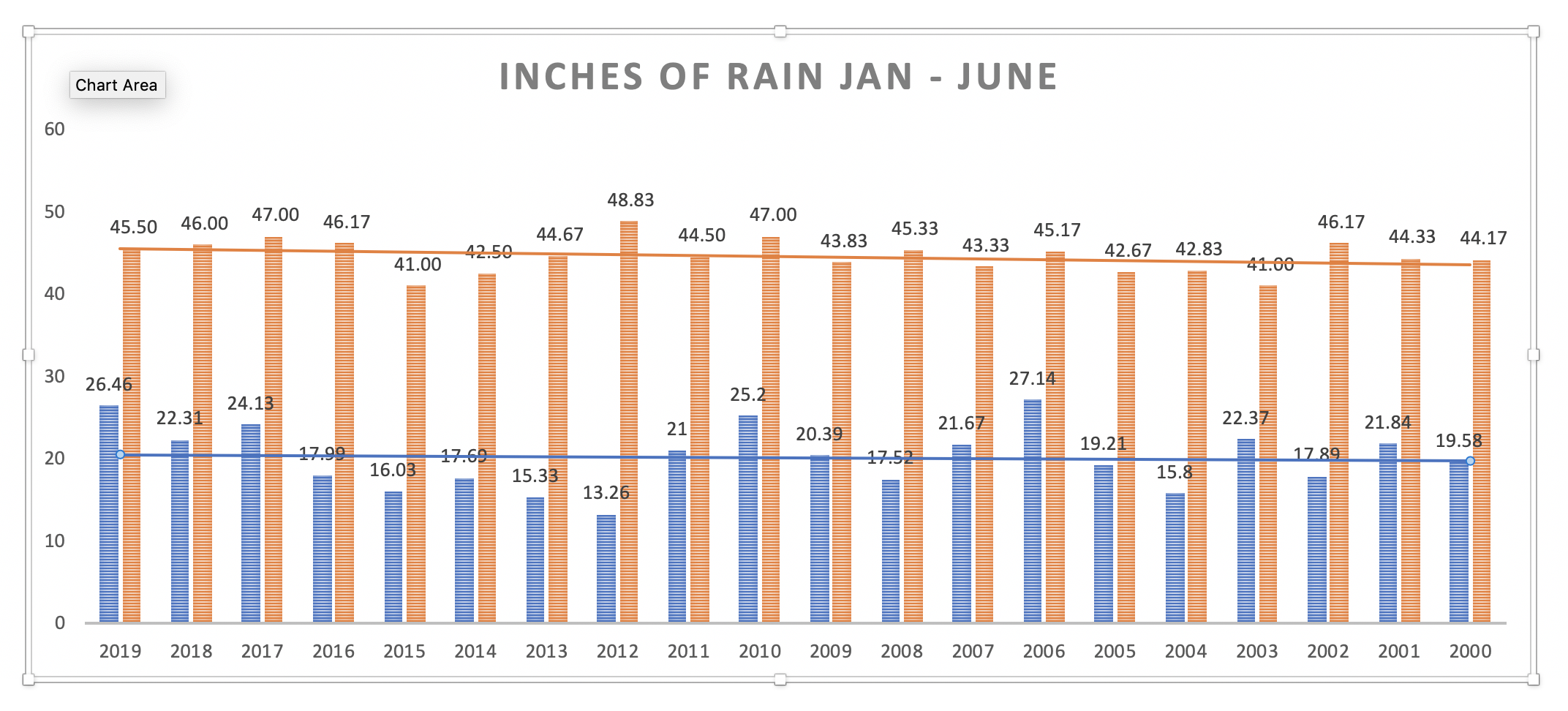
To test this I tabulated historic data going back to 2000: a) total precipitation in inches for 6 months (January to June), b) average temperatures measured daily for the same 6 months (January to June). The linear trendlines computed by Excel over the 20 year period, show a slight increase of about 1 degree in average temperature and an increase of about 1 inch of rain per 6 months. Online source of data.

Inches of rain for 6 month period (blue) and average temperature for same 6 month period (red). Measurements are from Westerly State Airport, Rhode Island, about 15 miles north of Montauk.

Warmer air carries more humidity and this leads to heavier rainfall and flooding. It is happening locally and it is a clear and present danger.

Clean energy is one major way we can fight this trend.

From Kate Mueth on June 25th after a few hours of rain fall:

Why all the fuss?

This is a cross section (a real piece) of the existing Block Island cable for their wind farm, consisting of 5 wind turbines that produce all the energy for the island with surplus energy for the state of Rhode Island. It is on my kitchen table. It measures 7 inches in diameter. It is similar to the cable that will bring energy from the South Fork Wind farm ashore.

“Carbon-free New York by 2040” is the overriding goal. Period.

If the urgency of achieving this goal is not apparent to any readers, just look at the most recent local news: “Higher tides force Shelter Island Ferry to rebuild ramps” This is a very real cost of sea level rise here on the South Fork! Check it out via Newsday.com.

And this is just the beginning.

On the other side of the issue we have loud opponents of the South Fork wind farm:

1) wealthy homeowners, with mansions on the Wainscott beach, who oppose any cable coming ashore in their vicinity, clearly a case of NIMBY

2) fishermen that have been whipped up with scare tactics.  I note that there are only 2 commercial fishing boats out of Montauk that fish in the Southfork wind farm area (OCS-A 0486, near Cox Ledge) which is closer to Rhode Island and Martha’s Vineyard than to Montauk.  From Montauk it takes 5 hours to get there by boat and 5 hours back.

For all those worried about a disruptive cable running under the sea bed and coming ashore somewhere, I would point out that a larger electric cable already feeds power in to Long Island coming all the way from New Jersey.  This dates back to 2007!  Like a giant extension cord, this transmission cable, named Neptune, stretches 50 miles underwater from Sayreville, N.J., comes ashore at Jones beach and has been plugged into Long Island for all these years without any nefarious effects on, or off shore. It is a 10″ cable and provides 660 megawatts.  

Likewise LIPA imports power from New England on the 330-megawatt Cross Sound Cable, which runs underwater from Connecticut. Two older cables, the 600-megawatt Y49 cable and the 599-megawatt Y50 cable, also run under the Sound to the Island.

Initial concerns about the effects on the shell fish industry were apparently not a problem over all these years.

Read more here: